
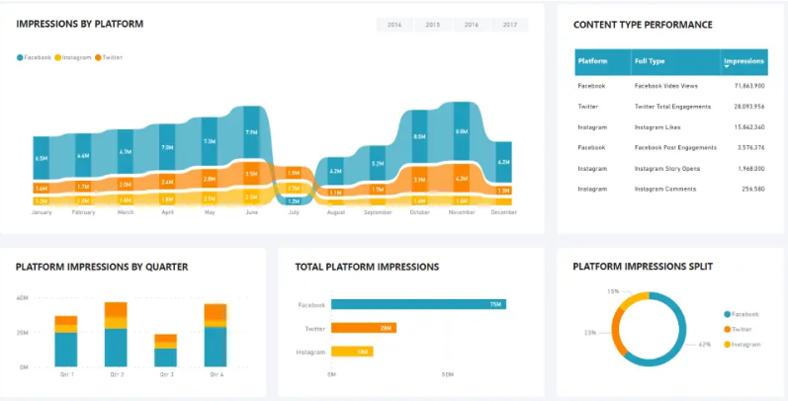
Real-time and Streaming Data: With the increasing availability of real-time and streaming data sources, there is a growing demand for dashboards that can handle and display live data. Organizations are seeking to monitor and analyze data as it is generated, allowing for immediate insights and timely decision-making.
Mobile Responsive Dashboards: As mobile devices become more prevalent and users increasingly rely on them for accessing information, the demand for mobile-responsive dashboards is on the rise. Designing dashboards that are optimized for mobile devices ensures users can access critical data and insights on the go.
Self-Service Analytics: Organizations are embracing self-service analytics, empowering business users to create and customize their own dashboards without relying heavily on IT or data teams. User-friendly dashboarding tools with drag-and-drop interfaces and intuitive features allow users to explore and visualize data independently.
Advanced Data Visualization Techniques: Dashboards are incorporating more advanced data visualization techniques to present data in engaging and interactive ways. This includes the use of infographics, heatmaps, treemaps, network diagrams, and other innovative visualizations to provide deeper insights and enhance the user experience.
Artificial Intelligence (AI) and Machine Learning (ML): AI and ML techniques are being integrated into data dashboarding to provide automated insights, anomaly detection, and predictive analytics. These technologies can help identify patterns, trends, and outliers in large datasets, enabling users to make data-driven decisions more efficiently.
Natural Language Processing (NLP): NLP capabilities are being incorporated into dashboards, allowing users to interact with the data using natural language queries or voice commands. This makes it easier for users to explore and analyze data without the need for complex queries or technical expertise.
Integration with Data Governance and Security: As data governance and security become increasingly important, data dashboards are incorporating features to ensure compliance and protect sensitive data. This includes role-based access controls, data encryption, and auditing capabilities to track user interactions with the dashboard.
Embedded Analytics: Organizations are embedding dashboards and visualizations directly into their existing applications or portals, providing users with seamless access to data insights within their familiar workflow. This integration enhances user adoption and makes data-driven decision-making a part of everyday operations.
Storytelling and Narrative-driven Dashboards: Dashboards are moving beyond simple data presentation to tell compelling stories and narratives. By incorporating contextual information, annotations, and narratives, dashboards can guide users through the data, helping them understand the insights and implications more effectively.
Augmented Reality (AR) and Virtual Reality (VR): Emerging technologies like AR and VR are starting to find applications in data dashboarding. These immersive technologies provide users with a unique and engaging way to explore data in three-dimensional spaces, facilitating deeper understanding and analysis.
These trends reflect the evolving nature of data dashboarding, driven by advancements in technology, user expectations, and the increasing need for data-driven decision-making across various industries and domains.