
Eliminate spreadsheet errors, data cleaning boosts accuracy for your SMB's decisions
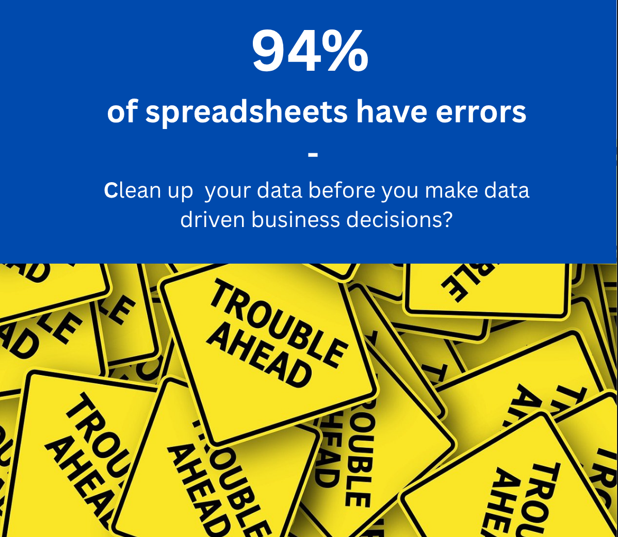
If you’re a financial manager, marketer, HR specialist, or operations lead, you probably rely on spreadsheets every day to make critical decisions. But what if we told you that 94% of spreadsheets used in businesses contain errors—many of them serious enough to affect strategic outcomes? How can you
eliminate spreadsheet errors and boost accuracy in your small or medium businesses?
That figure comes from a 2024 global research review of spreadsheet accuracy across industries. Even more startling, according to Researchgate, roughly 1 in 20 formula cells in operational spreadsheets contains a mistake. For small and medium businesses (SMBs), this should be a wake-up call. When your reporting tools are riddled with unseen flaws, how confident can you really be in your decisions?
This blog explores how to move your data from messy to meaningful—by cleaning, standardizing, and automating your data processes to build reports you can trust.
The Hidden Cost of Spreadsheet Errors in SMBs
Spreadsheets are the default tool for budgeting, workforce planning, customer tracking, and campaign analysis. They’re fast and familiar—but also alarmingly prone to error. In smaller businesses, where team members often wear multiple hats and reporting duties are decentralized, spreadsheet errors can silently undermine performance reviews, forecasts, or compliance reports.
Imagine finalizing a sales strategy based on flawed pipeline figures or reporting false cost savings to leadership. The cost of inaccuracy isn’t just reputational—it’s financial. And unfortunately, it’s also common.
The Data Cleaning Checklist: First Line of Defense
You can’t fix what you don’t examine. Every functional area in an SMB—finance, marketing, HR, operations—needs a simple, consistent approach to spotting spreadsheet flaws before they derail your work.
Here’s a quick data cleaning checklist to apply across departments:
- ✅ Remove duplicates (e.g. same vendor or employee listed twice)
- ✅ Standardize formatting (e.g. dates, currencies, capitalisation)
- ✅ Fill in missing values (e.g. blank cells in key columns)
- ✅ Check for data type errors (e.g. numbers stored as text)
- ✅ Normalize naming (e.g. “Johannesburg” vs. “Joburg”)
These steps are essential for reducing the odds that your spreadsheets join the 94% statistic.
Automating Data Quality: Less Manual, More Accurate
Manual cleaning is time-consuming—and prone to human error. Tools like Power Query and Power BI let you automate the cleaning process so your data flows in fresh and accurate, every time. Beacon Data Analytics works with SMBs to set up data pipelines that:
- Auto-detect and remove duplicates
- Flag anomalies and data inconsistencies
- Convert source files into structured, analysis-ready formats
This removes guesswork from your spreadsheets and replaces it with confidence.
Standardizing Metrics Across Systems = Trustworthy Reports
Most SMBs use multiple systems for different functions—payroll software in HR, CRM in marketing, spreadsheets for finance, etc. But each of these might define common metrics differently. What counts as “revenue” in one system might not in another. It is a challenge to eliminate spreadsheet errors to boost accuracy in your SMB. This will ensure one version of the truth throughout your business.
Beacon helps clients align and standardize key business metrics across systems, ensuring that when marketing and finance pull reports, they’re not comparing apples to oranges. With fewer manual reconciliations, your team gains time and eliminates another layer of potential spreadsheet error.
Creating an Audit-Ready Data Culture
Data integrity isn’t just about efficiency—it’s also about accountability. Whether for compliance, audit prep, or investor due diligence, being able to trace where a number came from is critical. That’s only possible with structured, documented processes.
Best practices include:
- Logging data sources and transformations
- Version-controlling reports and models
- Creating templates with built-in validations
A clean spreadsheet should be the beginning of trust, not the end of it.
From “Good Enough” to Zero-Error: Your Competitive Advantage
It’s tempting to treat minor spreadsheet flaws as the cost of doing business—but with 94% of spreadsheets containing errors, “good enough” often means “fundamentally flawed.” In SMBs, where margins are tight and decisions fast-paced, data precision becomes a competitive advantage.
Beacon Data Analytics specializes in helping businesses like yours clean, combine, and standardize data across platforms—turning unreliable reports into reliable insight. We help you build dashboards and models that give every department access to the same, trustworthy data.
Want to break free from the 94% and lead your team with better data?
Visit www.beacondataanalytics.com to discover how we help SMBs clean up their data and level up their decisions.
Also see https://beacondataanalytics.com/data-cleaning-essentials/